Poll results: Your experiences of using pharmacy services
548 people from across Sussex shared their views with us.
We heard:
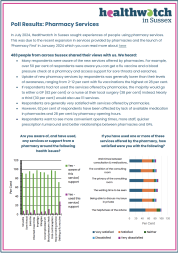
- Approximately half our respondents were aware of the condition’s pharmacies can treat and services they offer (e.g. vaccinations).
- The pharmacy treatments or services that respondents were least aware of were shingles, oral contraception, and uncomplicated urinary tract infections (UTIs).
- Pharmacy services used most were Flu (46%) and COVID (35%) vaccinations. Least used, were stop-smoking services and emergency oral contraception (both 0.7%).
- If respondents had not used services offered by pharmacies, most would contact their GP (60%), a nurse at their local surgery (29%), or NHS 111 by phone (16%) instead.
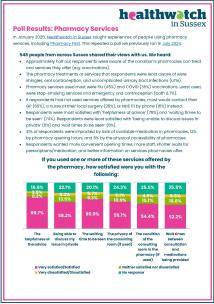
- Respondents were most satisfied with ‘helpfulness of advice’ (78%) and ‘waiting times to be seen’ (74%). Respondents were least satisfied with ‘being unable to discuss issues in private’ (6%) and ‘wait times to be seen’ (6%).
- 31% of respondents were impacted by lack of available medication in pharmacies, 12% by pharmacy opening hours, and 6% by the physical accessibility of pharmacies.
- Respondents wanted more convenient opening times, more staff, shorter waits for prescriptions/medication, and better information on services pharmacies offer.
Compared to our 2024 pharmacy poll:
- Public/user awareness of the services or support offered by pharmacies, including Pharmacy First, were relatively high in both 2026 and 2024 (45% vs 42%), but rates of usage continue to appear relatively low in comparison.
- The pharmacy services or support our respondents used most frequently in 2026 were the same as in 2024: flu vaccinations (46% vs 24%); blood pressure checks (13% vs 7%); and treatments for sore throats (8% vs 5%).
- The pharmacy services or support our respondents used least frequently in 2026 were the same as in 2024: Impetigo (0.9% vs 0.6%); Oral contraception (0.7% vs 0.8%); and Stop smoking services (0.7% vs 1.4%).
- 2026 poll respondents indicated they were less likely to visit their GP (70% vs 60%) or practice nurse (32% vs 29%) for support with Pharmacy First conditions than in 2024. However, indicated a slightly higher likelihood of using A&E (5% vs 3%), NHS 111 by phone (16% vs 15%), and similar rates for using an Urgent Treatment Centre or Minor Injury Unit (8% vs 8%).
- The services most identified by respondents as those they would turn to if they could not access them at a pharmacy remained the same in 2026 as in 2024. These were their GP (59.9% vs 69.4%), a nurse at their local practice (28.5% vs 32.3%) and NHS 111 by phone (16.2% vs 15.1%).
- The issues most identified by respondents as affecting access to medication from a pharmacy were the same in 2026 as in 2024. These included lack of available medication (31% vs 34%); the pharmacy not being open when needed (12.2% vs 15.5%); and barriers due to pharmacy locations or accessibility (5.7% vs 4.8%).
Feedback on pharmacies
Respondents to our 2026 poll most frequently told us in comments that:
- They’d like to see pharmacies open longer and more flexibly, ideally more often outside working hours (9 to 5), during lunchtimes and at weekends
- Shorter waits would be valued, especially for prescriptions, but also to access advice and support at peak times
- Their local pharmacy provided a quality service that met their needs, with praise for customer service and staff professionalism and care
- Shortages of medication are frustrating and can mean increased anxiety for customers or the need to visit multiple pharmacies
- They’d like improved communication with customers and more personalised care, including greater privacy and confidentiality when speaking to pharmacy staff
- Information on the services pharmacies offer outside of prescriptions and medication could be clearer and more consistent.
These themes largely repeat the themes we heard from respondents to the same question in our 2024 pharmacy poll.
This suggests some significant issues remain for services users around barriers accessing pharmacy services, medication availability, and inconsistent information on the additional services pharmacies offer.
Next Steps
As the public champion for local health and care services, Healthwatch will continue to work in partnership with commissioners and providers to monitor the experiences of patients and the public in accessing health and care services locally and explore how ongoing improvements may be delivered.
We will also share this report with NHS England, Care Quality Commission, Healthwatch England and others to share this insight and encourage its incorporation into future initiatives.
Download the report
Have you recently used a health or care service in West Sussex?
Please tell us your experiences of local health and care services via our Feedback Form and let us know how this has been for you.
Help and support with Health and Care
If you need help or support related to health or social care, then please contact our Information & Signposting Service via 0300 012 0122 or helpdesk@healthwatchwestsussex.co.uk