Poll results: Recent Changes to GP practices
In September 2025, we sought people’s experiences of recent changes to GP practices, including using technology to access health services the introduction of new staff roles.
603 people from across Sussex shared their views with us.
Respondents being treated in the NHS and in GP surgeries
- Respondents who had not experienced care or treatment from staff in new roles:
- 87% hadn’t used a health and wellbeing coach,
- 89% hadn’t used a dietitian,
- 60% hadn’t seen a paramedic.
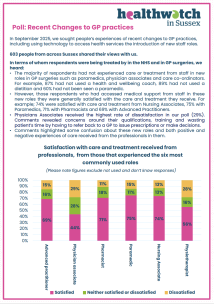
- Among the respondents who had experienced care or treatment from staff in new roles, satisfaction was generally high:
- Nursing Associates (74%)
- Paramedics (75%)
- Pharmacists (71%)
- Advanced Practitioners (69%)
- Physician Associates had the highest dissatisfaction (29%), with concerns around their qualifications, training and wasting patient’s time by having to refer back to a GP to issue prescriptions or make decisions.
- Comments highlighted some confusion about these new roles and both positive and negative experiences of care received from the professionals in them.
Satisfaction with care and treatment received from professionals
Advanced practitioner (69%)
Physician associate (44%)
Pharmacist (71%)
Paramedic (75%)
Nursing Associate (74%)
Physiotherapist (56%)
Using technology to access health care
- 62% felt either very confident or somewhat confident about using technology to access support for their health needs.
- Most-used online GP services used in the last 12 months:
- Ordering repeat prescriptions (75%)
- Finding out test results (59%)
- Least used online GP services used in the last 12 months:
- Registering with a practice (3%)
- Making an administrative request (13%)
Ease of Online Access
- Easiest: ordering repeat prescriptions, accessing medical records and finding out test results.
- Hardest: registering with a practice online.
Respondents' experiences of using online forms to contact their GP
- 47% rated online forms good/very good, 31% poor/very poor.
- Highly-rated: follow up communication they received after the consultation (58% very good or good).
- Most problematic: ease of finding forms (21% poor or very poor) and appropriateness of questions asked in the form (32% poor or very poor).
What type of training or support would best help you to become more confident in using technology and online support to access support for your health needs?
- 26% animations or short films showing how to use the service would help,
- 25% already felt confident and did not need any training or support,
- 13% group coaching or mentoring at the GP surgery would help,
- 10% E-learning courses or one-to-one help and support would best support,
- 28% ‘none of the above – I do not want to use online health services.
Report: Recent Changes to GP practices
Read the full results with targeted data and respondent feedback.