NHS Sussex Sensory Impairment Health Inequalities Summary
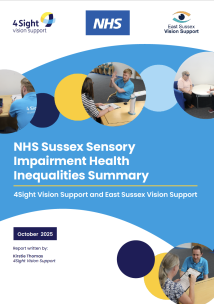
This report, produced by 4Sight Vision Support and East Sussex Vision Support, highlights major health inequalities affecting blind and partially sighted people across Sussex.
Findings show that barriers in communication, accessibility, transport, emotional support, and service awareness significantly impact health outcomes and wellbeing.
Key Issues Identified
1. Communication Barriers
Many visually impaired patients do not receive NHS communication in accessible formats, resulting in:
- Missed or confusing appointments
- Difficulty understanding medical information
- Increased stress and reduced independence
Preferred formats (audio, large print, email, etc.) are inconsistently offered. This violates the NHS Accessible Information Standard (AIS).
2. Accessing NHS Services
The majority of respondents struggle to attend appointments independently:
- 68% of respondents felt they could not attend their medical appointments independently.
- 46% of respondents are unable to attend appointments independently stating mobility as one of the main contributing factors.
- 51% of respondents see navigating the environment as a barrier to independent attendance.
- 85% of respondents stated they require assistance getting to and from appointments. Support from family and friends being the most common form of transport assistance.
- 6% of respondents saw their sight condition as a barrier to accessing the appropriate care and support needed as an inpatient.
3. Mental Health and Multimorbidities
Living with visual impairment often intersects with other health problems:
- 27% of respondents reported experiencing mental health issues (anxiety, depression, and PTSD).
- 22% of respondents went untreated due to barriers in accessing appropriate mental health services.
- Many also live with other health conditions such as diabetes, heart problems, and hearing impairments.
4. Low Awareness of Support Services
Large numbers of respondents were unaware of available support:
- 57% of respondents did not aware if there was an ECLO/SCA in the eye clinic they attend.
- 48% of participants were unaware of Low Vision Services.
- 79% of respondents were not made aware of services and support available at the point of diagnosis.
- 33% of respondents discharged from the eye clinic were made aware of the importance of regular eye health checks.
This leads to isolation, frustration, and reduced ability to self-manage health.
Impact
Poor communication, inaccessible services, and lack of emotional support contribute to:
- Missed appointments
- Declines in mental health
- Worsening vision
- Unsafe or stressful inpatient environments
- Reduced quality of life
Recommendations
- Improve Communication
- Enhance Mental Health Support
- Increase Accessibility
- Raise Awareness of Support Services
- Sight Loss awareness training for NHS staff
- Integrated Health Services
Download: NHS Sussex Sensory Impairment Health Inequalities Summary
This report seeks to identify key issues, barriers, and trends, and provide recommendations to help address these inequalities.
It is important to note; this project was funded by the NHS Sussex Health Inequalities Small Grants Fund.
4Sight Vision Support
An independent charity dedicated to supporting and engaging with people across West Sussex who are blind or partially sighted. Empowering people by providing tailored support, building confidence, and promoting inclusivity.
Website: 4sight.org.uk
Call: 01243 828 555
Email: enquiries@4sight.org.uk
East Sussex Vision Support
East Sussex Vision Support aim is to increase the independence, confidence and well-being of blind and partially sighted people and also work to promote the understanding of sight loss and it’s challenges in local communities, businesses, schools and organisations.
Website: eastsussexvisionsupport.org
Call: 01323 832252